Complete more condominium and strata audits without growing your headcount. Condo Audit Pro is purpose-built condominium and strata audit software: it automates the repetitive preparation — document intake, extraction, GL comparison, sampling, invoice checking, and output assembly — while your CPAs keep every professional judgment and every signature.
The preparation work that used to take your staff days per file is done before the CPA sits down. Your team reviews exceptions, follows up, and supports the CPA — not re-keying spreadsheets.
AI is advisory only — it never concludes, signs, approves, selects samples, sends questions, or closes a file. Every judgment and every sign-off stays with the licensed CPA.
Every upload, check, flag, question, decision, and output for every engagement — retained in full, year over year, ready for any future practice review.
A typical small condominium audit takes about 20 hours of preparation in Excel workbooks and desktop audit templates. Here is where those hours go, stage by stage, and what they become on the platform: about 5 in total (our estimate).
Every engagement and its status, worked out from the file itself.
Engagement, acceptance, independence and the building’s facts — from documents, not retyping.
Planning papers pre-filled from the client, the documents and last year.
One client portal with named slots; every file checked on arrival.
Records read and reconciled, the ledger matched, adjustments proposed, funds pre-filled.
Accounts classified and mapped once, remembered by your firm; controls pre-filled.
A sample on your rules, invoices matched, every journal scanned, every owner’s fees tested.
Leadsheets pre-filled with evidence; the facts every document needs.
Findings, questions, reviews, the opinion, eleven documents and the close.
See every one of the 47 screens, today and with the platform, on How it works.
The platform prepares the file. Every judgment stays with the licensed CPA.
Document reading and extraction, bank statement parsing, GL comparison and trial balance, sample preparation using your firm’s rules, invoice checking, flag creation, question drafts, working papers, and output assembly.
Materiality judgment, sample approval, flag resolution, client-question approval, audit conclusion, report signing, and file close. Only the CPA can close — the platform enforces that separation.
Condo Audit Pro is not document storage with a logo. It is a set of purpose-built audit engines that turn verified client records into structured, tested audit data — each one configured by your firm, and each one stopping where the CPA’s judgment begins.
Ledger lines are compared to bank and source records using your firm’s tolerances for amount, date, and reference. The CPA reviews exceptions — not every line.
Every sampled invoice is checked against the books for amount, date, vendor, classification, and cutoff. Differences surface as exceptions for the CPA.
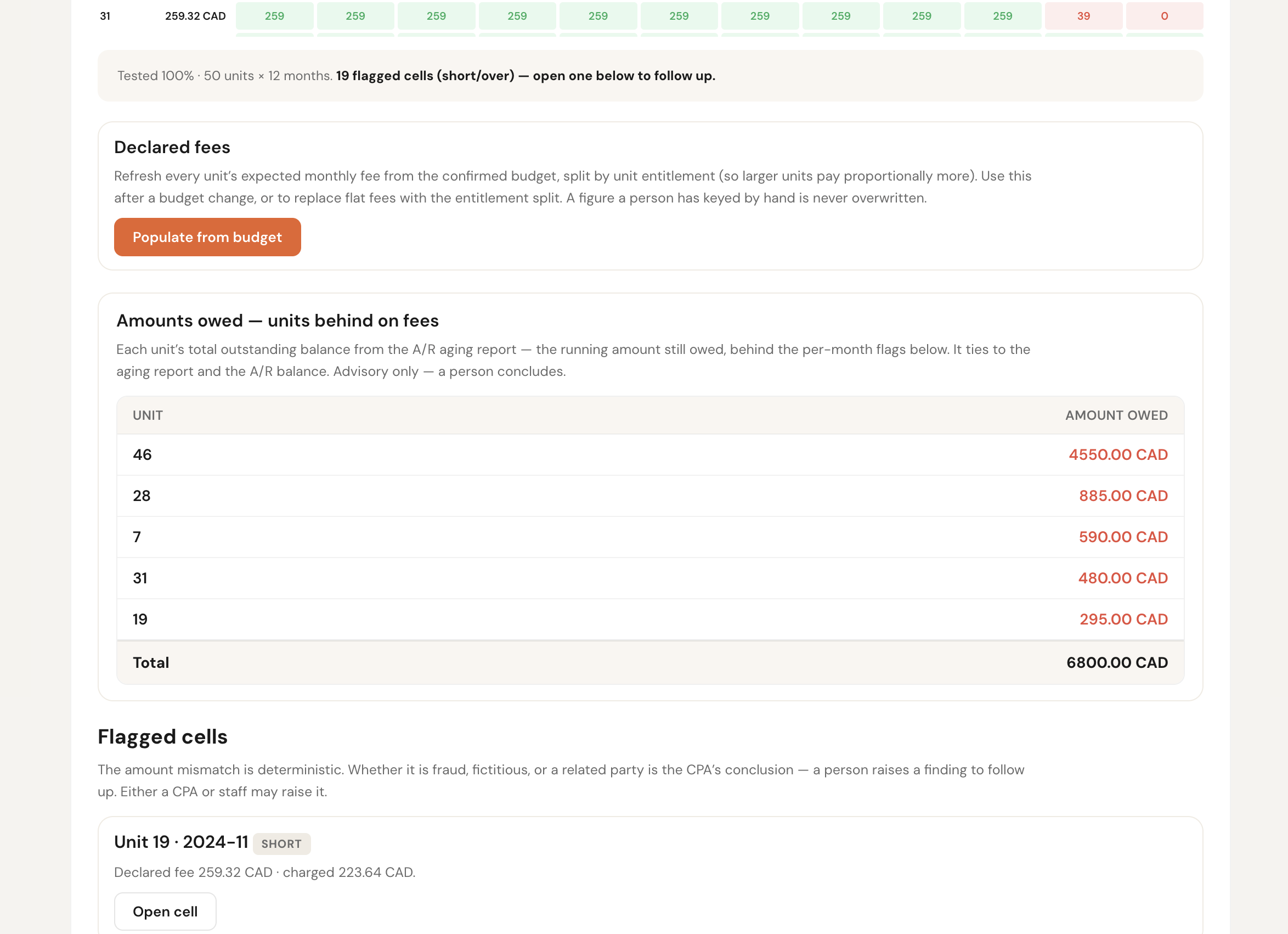
Owner fee revenue is tested for every unit, every month — up to 1,200 unit-month checks on a 100-unit corporation. Coverage a manual sample can’t match.
Built from the confirmed ledger, footed to the dollar, tied to prior-year closing balances, and versioned — the same approved figures feed every working paper and statement.
Calculated from your firm’s own basis and percentages — overall, performance, and clearly-trivial. The platform computes the numbers; the CPA judges significance.
Testing selections are prepared by your firm’s configured rules — reproducible, never decided by AI — and every selected item shows why it was chosen.
The full journal-entry population is screened against visible risk indicators — round-dollar, period-end, missing references. The software finds the unusual; the CPA decides what needs work.
Operating and reserve funds with contributions, transfers, interest, and expenditures — continuity reconciled to the trial balance, in each province’s own terms.
Classify an odd account once and save it as a firm rule — visible, editable, and traceable — so it’s recognized automatically on every future audit.
Bank, investment, and receivable confirmations tracked from sent to returned in one register — with differences and alternate procedures recorded.
Last year’s statements are read straight into this year’s comparative columns — proposed for the CPA to confirm, edit, or reject.
The file cannot close until reviews are complete, questions are answered, and sign-offs are in place — and only a CPA can close, enforced by the system itself.
Every important calculation uses fixed, explainable rules — the same inputs always give the same answer. AI only reads documents and drafts suggestions. There is no field in the database where an AI conclusion could even be stored.
Automation fills in blanks only. If a person typed or confirmed a value, re-running any process can never replace it. The human’s word stands until a human changes it.
When the second audit runs faster, it’s because your firm’s earlier decisions were saved as visible, editable rules you can open, change, or delete. No AI model is trained on client data, and nothing learned is hidden.
Province templates set the legal and reporting structure. Firm settings sit on top — materiality, sampling rules, variance thresholds, cutoff windows, matching tolerances, and management-fee benchmarks — applied consistently while professional judgment stays with the CPA.
Set your firm’s materiality approach and sampling rules once. The platform applies them consistently across every engagement.
Budget variance thresholds, GL matching tolerances, and cutoff windows are all configurable to match your firm’s audit approach.
Alberta, British Columbia, and Ontario each get their own financial statement wording, letters, and board-ready packages.
Every factor that adds time to a condominium or strata audit is handled inside the platform — so the preparation is done before the CPA sits down.
Surfaced and tracked through the investments and capital-asset checks, ready for the CPA to review.
Every bank and reserve account is read, compared to the GL, and reconciled in one place.
Unit schedules, fee calculations, and the revenue grid handle hundreds of units without extra work.
Mid-year changeovers are handled with split-period processing and comparative flags.
Separate fund columns for townhome and apartment classes, with combined totals on one set of statements.
Related-party balances are flagged and tracked against the appropriate disclosure requirements.
Reserve study dates, balances, and contribution comparisons are built into the checks.
At 100 audits a year, preparation the usual way takes about 2,500–4,000 staff hours — one and a half to two and a half full-time staff. With the platform, about 625–1,000: under half of one senior’s year, freeing roughly $110,000–$180,000 of staff time (our estimate, at typical Canadian audit salaries). On the Professional plan the platform costs $300 per audit at full volume, a flat fee that never changes with a building’s size. The rest of what you charge stays with your firm.
See All Plans →We never contact, market to or refer your clients. Your engagement data is isolated to your firm by the database itself, is never shared with another firm, and is never used to train public AI models. Your finished reports and working papers are yours to export at any time.
In each of Alberta, British Columbia and Ontario, one CPA firm leads the condominium and strata audit practice on the platform. Contact us to learn more.
About the partnershipBook a demo and we’ll walk your firm through a condominium audit end to end.
Book a CPA Demo →